New Academic Session, Rising School Costs: Are Parents Paying the Price for Weak Regulation in Jammu & Kashmir?
Education | Jammu & Kashmir | Private Schools | Parents’ Concerns
Srinagar 30 October 2026: Books, uniforms, transport charges and disputed fee demands are once again putting household budgets under pressure. But behind the growing frustration lies a bigger question: why do parents continue to struggle when Jammu & Kashmir already has regulations governing private school fees and purchases?
SRINAGAR: For thousands of families across Jammu & Kashmir, the beginning of a new academic session is supposed to bring excitement, fresh expectations and another opportunity for children to learn. Yet, for many parents, the opening weeks of the school year bring a different experience: a long list of expenses, instructions from schools, purchases from designated vendors and little room to question the bills.
The cost of educating a child is no longer limited to tuition fees. Parents must often arrange money for textbooks, notebooks, uniforms, shoes, transport, activity material and other school-related expenses. When several of these payments arrive together, even an ordinary academic transition can become a serious financial challenge.
The concerns are not entirely new. Parents in Srinagar, Baramulla, Budgam and other parts of the Valley have repeatedly raised complaints about restrictions on where books and uniforms can be purchased, expensive supplementary material and demands that they believe lack sufficient justification.
However, the issue deserves a closer examination than simply blaming private schools or describing every additional charge as illegal. Jammu & Kashmir has a statutory fee-regulation mechanism, government instructions governing the purchase of books and uniforms, and a history of official intervention. The real question is whether these safeguards are being implemented effectively and whether parents can obtain timely relief when they encounter questionable practices.
Recent government action suggests that the administration itself recognises the problem.
The Book Burden: When Buying Textbooks Becomes a Compulsory Exercise
Among the most persistent complaints raised by parents is the cost of textbooks and supplementary learning material.
The problem is not simply that books are expensive. It is the lack of choice that parents say they sometimes encounter while purchasing them.
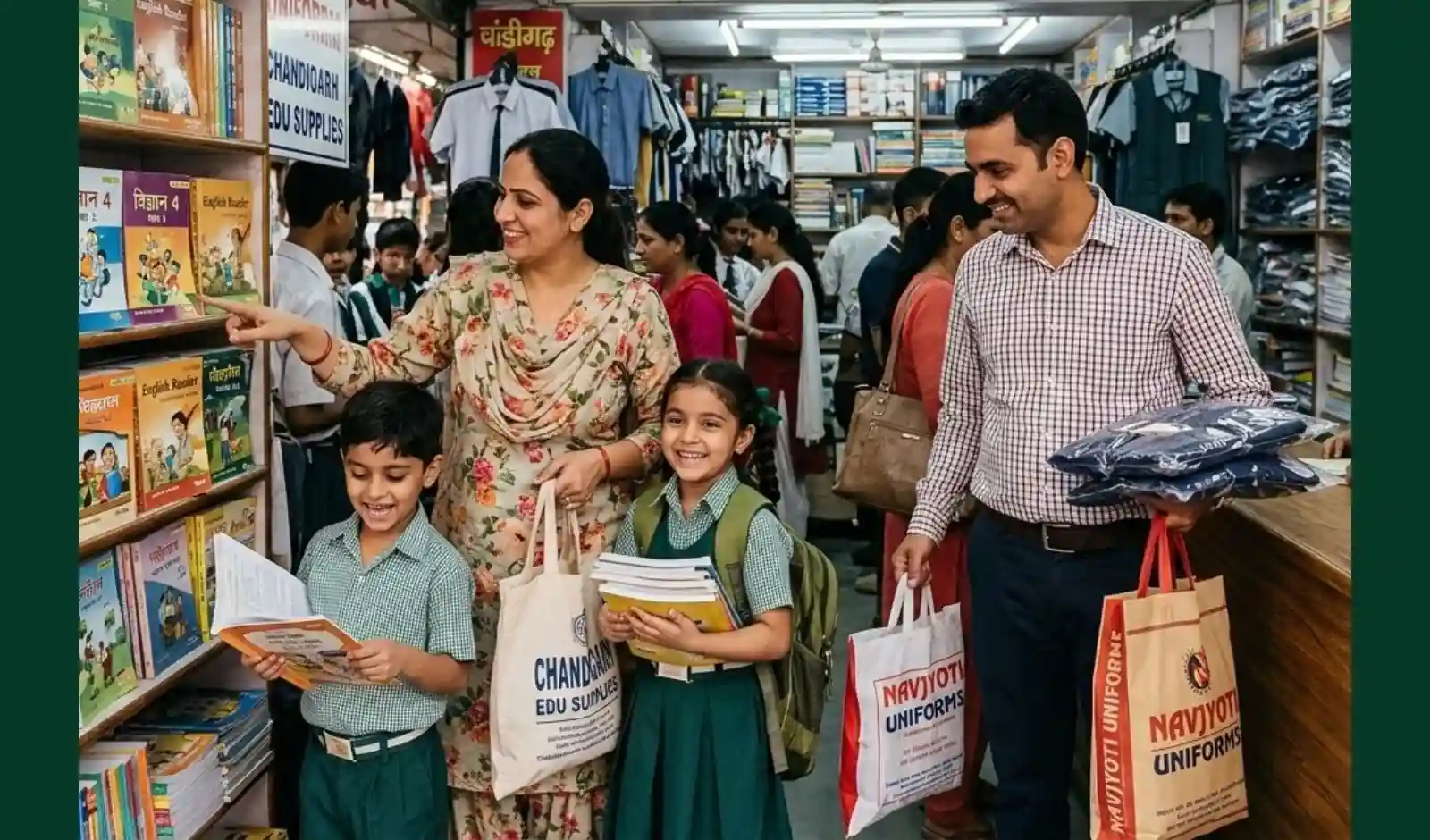
In several reported cases, parents have alleged that schools direct them towards particular bookshops or suppliers. Some have also complained that prescribed textbooks are difficult to find in the open market, while certain institutions have allegedly arranged book sales within their own premises.
A March report by The Kashmir Monitor documented complaints from parents in Srinagar, Baramulla and Budgam. Parents alleged that particular shops had become the only practical source of school books or uniforms. The report also quoted Asma Lone, president of the Parents’ Association of Privately Administered Schools (PAPAS), who raised concerns about vendor monopolies and pressure on families.
These are reported allegations, not findings against every private school. Nevertheless, the consistency of the complaints raises an important regulatory question: if textbooks are prescribed for educational purposes, why should parents have to depend on a limited number of sellers to obtain them?
The financial consequences can be considerable.
A family with two or three school-going children may have to purchase multiple sets of textbooks, notebooks, workbooks and activity material within a short period. The expense becomes particularly difficult when schools prescribe different publishers or introduce new editions every academic year.
There is also a legitimate academic question about supplementary material.
Additional books can be useful when they improve understanding, provide exercises or support a clearly defined learning objective. But when supplementary material becomes compulsory without a transparent explanation of its educational value, parents have grounds to seek clarification.
The distinction between an academically necessary resource and an unnecessary commercial expense should not be left entirely to the discretion of individual institutions.
The High Court’s June 2026 Judgment: A Significant Development in the Textbook Debate
The textbook controversy has also acquired an important legal dimension.
On June 6, 2026, a Division Bench of the Jammu & Kashmir and Ladakh High Court, comprising Justice Sindhu Sharma and Justice Shahzad Azeem, dismissed an appeal filed by the J&K Private Schools United Front.
The dispute concerned the Jammu and Kashmir Board of School Education’s directions requiring affiliated private schools to adopt Board-published textbooks for Classes VI to VIII.
The private schools’ representative body had challenged the directions, arguing that the Board could prescribe the curriculum but could not compel institutions to use only textbooks published by the Board itself.
The High Court rejected that argument. It held that the Board’s statutory authority to prescribe curricula and textbooks extended to determining which textbooks affiliated institutions must use. The court also affirmed the earlier single-judge ruling of September 8, 2023.
The judgment is significant for parents because it reinforces the regulatory authority of the education board over curriculum and textbook selection in affiliated schools.
However, one distinction is essential: the judgment does not establish that every private publication is inherently unsuitable or that all additional educational material is automatically illegal. Its central finding concerns the Board’s statutory power and the obligation of affiliated schools to follow its prescribed curriculum and textbooks.
For parents, the practical implication is that schools cannot simply disregard applicable Board directions when deciding which textbooks students must use.
The challenge now is to ensure that textbook requirements are communicated clearly, followed consistently and made accessible to families without unnecessary commercial restrictions.
Uniforms and the Problem of Restricted Purchasing Choices
School uniforms are another recurring source of frustration.
Uniforms serve a legitimate purpose. They create a common dress standard, reduce visible economic differences among students and help maintain institutional discipline.
But the question changes when parents are told that uniforms must be purchased from one particular shop or supplier.
Parents have previously complained that even when they find apparently identical uniforms in the open market, schools reject them over minor differences in colour, fabric or design.
The Kashmir Monitor’s reporting documented such complaints, including allegations that schools changed uniform requirements frequently and restricted purchases to selected sellers.
For a family with multiple children, the cost can extend well beyond the initial purchase. Different seasonal uniforms, sportswear, sweaters, shoes, ties, belts and other accessories add to the annual expenditure.
The issue is not whether schools should maintain uniform standards. They should.
The issue is whether maintaining those standards requires parents to surrender their freedom to choose where they purchase the prescribed items.
A more transparent system would allow schools to publish exact specifications, including colours, fabric, design and other requirements, while making it clear that parents can purchase matching items from any suitable market source.
This would protect institutional standards without creating unnecessary dependence on individual vendors.
Curriculum Confusion: Who Decides Which Books Children Must Study?
The textbook issue also exposes a broader problem of communication between schools, education boards and parents.
Parents are often unfamiliar with the technical distinction between a prescribed syllabus, an approved textbook and supplementary learning material.
Schools, meanwhile, may use different resources for classroom teaching, assignments, practice exercises and examinations.
The result is confusion over what students actually need to purchase.
In Jammu & Kashmir, the Jammu and Kashmir Board of School Education (JKBOSE) has statutory powers relating to curricula, syllabi and textbooks. The June 2026 High Court judgment reinforced those powers in relation to affiliated institutions.
This makes transparency particularly important.
Schools should publish their prescribed booklists well before the academic session begins. Each book should be identified by its title, publisher, author and edition, along with an explanation wherever additional material is required.
Parents should also be informed about which books are prescribed by the Board and which are supplementary resources selected by the institution.
Such disclosure would make it easier for families to compare prices, identify unnecessary purchases and raise specific complaints.
It would also protect schools from unfounded accusations by allowing them to demonstrate the academic purpose of their requirements.
Fee Regulation Exists, But Implementation Remains the Central Challenge
One of the biggest misconceptions in the debate is that Jammu & Kashmir has no regulatory framework to control private school fees.
It does.
The Committee for Fixation and Regulation of Fee of Private Schools (FFRC) is the designated statutory mechanism responsible for regulating private school fee structures.
Its authority is rooted in the Jammu and Kashmir School Education Act, 2002, and the relevant private-school rules.
Under Section 20-C of the Act, private schools are required to submit their proposed fee structures, supported by relevant financial records and justification, for scrutiny by the committee. The applicable rules also require prior approval for fee revisions.
The FFRC’s official website lists the 2022 fee-regulation framework and subsequent orders governing private schools.
This is important because fee regulation is not supposed to depend entirely on what an individual school decides to charge.
Schools have legitimate operating expenses. They must pay teachers and other employees, maintain buildings, provide facilities, purchase equipment and meet administrative costs.
A sustainable private education system requires financial viability.
But financial viability does not mean unlimited freedom to increase fees or introduce charges without justification.
The purpose of the FFRC is to examine the financial basis of proposed fees and ensure that the interests of educational institutions do not override the rights of students and parents.
Official action against non-compliant schools
The FFRC’s own records reveal that enforcement has not been merely theoretical.
On July 31, 2025, the committee issued a notice concerning 153 private schools in Baramulla district that had allegedly failed to submit the required documents for regulation and determination of tuition and annual fees.
The notice referred to repeated communications and directed the institutions to submit their records within seven days. It also warned that continued non-compliance could invite action, including suspension of recognition or recommendations concerning withdrawal of the NOC.
In August 2025, the committee issued another direction giving defaulting schools a final opportunity to submit their fee-regulation files.
The FFRC’s circular records also show action relating to admission fees, advance fee collection, security deposits and the requirement to mention individual fee heads on receipts.
These developments demonstrate that regulatory provisions and enforcement powers exist.
But they also raise an uncomfortable question: why are complaints about school charges continuing despite repeated official interventions?
The answer may lie in the gap between issuing directions and ensuring compliance at the school level.
A notice is only the beginning of enforcement. Parents need to know whether complaints are investigated, whether violations are established, what penalties follow and whether the disputed money is refunded where appropriate.
Without publicly accessible outcomes, regulatory action can appear distant from the everyday experiences of families.
January 2026: Government Steps In to Examine School Fees, Books and Uniform Costs
Perhaps the clearest indication that the problem has reached the government’s attention came in January 2026.
Through Government Order No. 33-JK (EDU) of 2026, dated January 20, the Jammu & Kashmir Government constituted a committee under the chairmanship of the Secretary, JKBOSE, to examine the fees charged by private schools and the prices of books, uniforms, shoes and other items supplied to students.
The committee included representatives from the School Education Department and the FFRC.
Its mandate was particularly important. It was asked to determine whether the charges imposed by private schools, including the cost of books and uniforms, were based on verifiable parameters and had a sound, justifiable basis.
The panel was also asked to examine the legal basis for charging transport fees during winter vacations in Kashmir.
It was directed to submit its report within 30 days.
The order was an acknowledgement that the controversy extended beyond tuition fees.
However, an important question remains: what happened after the committee was constituted?
As of October 31, 2026, the publicly accessible material reviewed for this article does not establish whether the committee’s final report was submitted, what conclusions it reached or which recommendations were implemented.
That information should be made public.
If the government has completed its examination, parents deserve to know its findings. If the exercise remains incomplete, the administration should explain the delay.
Constituting committees without communicating their findings risks reducing an important public-interest exercise to another administrative formality.
Transport Charges: Another Expense That Needs Clarity
School transportation is among the most expensive recurring components of private education, particularly for families living far from their children’s schools.
In Kashmir, winter conditions make the issue more complicated.
Schools may close during winter vacations, but parents can still find themselves facing transport-related charges. This has prompted questions about whether transport fees should be collected when buses are not operating and students are not using the service.
The matter is not entirely straightforward.
Transport operators may have fixed costs, including vehicle maintenance, insurance, permits, staff payments and loan instalments. Some expenses continue even when buses are temporarily not operating.
At the same time, parents are entitled to understand what they are paying for and whether the amount is justified.
The FFRC’s official records show that the issue has received regulatory attention.
On February 24, 2026, the committee constituted a separate panel to determine transport fees for private schools, following directions of the High Court. The panel included senior representatives of the Transport Department and the Consumer Affairs and Public Distribution Department.
It was directed to submit its report within one month.
The development is important because transport charges should not be determined through arbitrary demands.
A transparent calculation should consider operational expenses, actual service arrangements, distance, vehicle capacity and the applicable regulatory directions.
Parents should receive a clear breakdown rather than a single unexplained figure.
The April 2026 Development: Parents’ Associations and Book Complaints
The FFRC’s official circular record provides another indication that the issue remained active during 2026.
Its website lists an April 17, 2026 circular concerning the creation of a Parents Association and another concerning complaints about the purchase of books from private publishers.
These developments are worth noting because they point towards two important aspects of school regulation.
First, parents need a collective platform through which they can raise concerns instead of approaching institutions individually.
Second, textbook-related complaints require a specific mechanism for examination. Fee disputes and curriculum disputes are connected, but they are not identical.
A school may have an approved tuition fee structure and still face questions about its textbook practices, vendor arrangements or supplementary material.
Similarly, a complaint about a particular book does not automatically establish that the school’s entire fee structure is unlawful.
Effective regulation must examine each issue on its own merits.
The creation of parents’ associations could help address the imbalance between individual families and large educational institutions, provided these associations receive meaningful access to the authorities and are not reduced to nominal bodies.
Why Middle-Class Families Are Feeling the Pressure
The financial burden of private education is not distributed equally.
For affluent households, a few additional school expenses may be manageable. For middle-class and lower-middle-class families, the same payments can affect essential household spending.
Consider a family with two children enrolled in private schools.
At the beginning of an academic session, the household may have to manage:
-
Tuition and annual school charges.
-
Textbooks, notebooks and supplementary books.
-
Summer and winter uniforms.
-
Shoes, sweaters and other accessories.
-
Transport charges.
-
Examination and activity-related expenses.
-
Digital learning or technology-related payments, where applicable.
Even when individual expenses appear manageable, their combined impact can be substantial.
The problem becomes more serious when payments are demanded within a limited period.
Parents who depend on monthly salaries, small businesses or seasonal incomes may have to borrow money, postpone other purchases or use savings to meet school-related expenses.
Families with three or more children face an even greater challenge.
This creates a broader educational concern.
If access to good schooling increasingly depends on a family’s ability to meet multiple additional expenses, the gap between children from financially secure households and those from modest backgrounds can widen.
Education should improve social mobility, not become another factor reinforcing economic inequality.
The Other Side: Why Private Schools Say Fees Cannot Remain Static
A fair examination of the issue must also recognise the financial realities of private educational institutions.
Schools operate in an environment where expenses are rising. Teacher salaries, electricity, heating, infrastructure maintenance, laboratory equipment, digital facilities and transport operations all require regular expenditure.
Institutions also face growing expectations from parents regarding teaching quality, extracurricular activities, technology and student facilities.
Private schools argue that these responsibilities require adequate financial resources.
There is also a distinction between schools with substantial infrastructure and those operating with limited facilities. Their operating costs cannot necessarily be assessed through one uniform financial formula.
However, this argument strengthens the case for transparent fee regulation rather than weakening it.
If a school needs to increase fees because of higher teacher salaries, infrastructure costs or other genuine expenses, it should be able to present the relevant financial justification to the competent authority.
Parents, in turn, should be able to understand what they are paying for.
The objective should not be to make private education financially unviable. It should be to ensure that legitimate institutional expenses do not become a justification for arbitrary collections or restrictive commercial practices.
Where Is the Accountability Gap?
The growing controversy points towards a problem that goes beyond individual schools.
Jammu & Kashmir has several institutions with responsibilities relating to private education:
-
School Education Department: Responsible for policy, supervision and administrative oversight.
-
JKBOSE: Responsible for curriculum, syllabi, textbooks and affiliation-related requirements within its statutory jurisdiction.
-
FFRC: Responsible for examining and regulating private school fee structures.
-
Directorates of School Education: Responsible for implementation, monitoring and action within their respective jurisdictions.
-
Consumer protection authorities: Relevant where a matter involves a consumer dispute or an unfair commercial practice within the applicable legal framework.
The difficulty for ordinary parents is understanding where to approach when something goes wrong.
A complaint about excessive tuition fees may fall within the FFRC’s jurisdiction. A dispute about compulsory textbook purchases may require intervention from JKBOSE or the School Education Department. A transport-related dispute may involve the applicable fee-regulation mechanism and transport authorities.
This division of responsibility can make grievance redressal confusing.
Parents should not have to visit multiple offices simply to establish which authority is responsible for examining their complaint.
A single, publicly accessible grievance portal, with complaints automatically routed to the appropriate authority, could make a meaningful difference.
It should provide complaint numbers, investigation status, deadlines and final decisions.
More importantly, the identities of parents and students should be protected where confidentiality is necessary.
What Parents Can Do: Know the Rules Before Paying
Parents are not powerless, although many may not be aware of the available regulatory channels.
A few practical steps can help protect their interests.
1. Ask for the official booklist
Request a written list of prescribed textbooks, publishers and editions. Ask schools to distinguish between Board-prescribed books and supplementary material.
2. Check whether purchases are restricted
If a school insists that books or uniforms must be purchased from a particular vendor, request the direction in writing and seek clarification from the education authorities.
3. Demand itemised fee receipts
Every payment should be supported by a proper receipt identifying the relevant fee head. Avoid undocumented cash payments.
4. Verify the approved fee structure
Parents can approach the FFRC to clarify whether the fee being demanded by a particular institution has been approved.
5. Preserve evidence
Keep copies of fee notices, booklists, bills, messages, circulars and receipts. These documents can help establish the facts when a complaint is investigated.
6. Use the official complaint mechanism
The FFRC publishes its contact details and regulatory orders on its official website.
Jammu & Kashmir Fee Fixation and Regulation Committee (FFRC)
0194-4034841 (Srinagar)
0191-2956990 (Jammu)
Ground Floor, Old Assembly Complex, Srinagar
Contact details published on the committee’s official website.
Collective complaints through recognised parents’ associations can also help authorities identify patterns that might otherwise appear to be isolated incidents.
What Needs to Change: From Official Circulars to Real Enforcement
The government does not necessarily need another long list of guidelines. Much of the regulatory framework already exists.
What is required is consistent implementation, public disclosure and measurable accountability.
1. Publish approved booklists and fee structures
Every recognised private school should make its prescribed curriculum, textbook list and approved fee structure easily accessible on its website and noticeboard.
2. End compulsory vendor arrangements
Schools should publish uniform specifications and allow parents to purchase matching products from the open market.
Where a particular supplier is genuinely necessary, the institution should provide a clear written justification and disclose any relevant commercial relationship.
3. Examine annual changes in textbooks
Schools should explain substantial changes in publishers, editions and supplementary material. Where books remain academically suitable, parents should not face unnecessary replacement costs.
4. Strengthen FFRC inspections
The committee should conduct regular compliance checks and publish school-wise information about approved fees, pending cases and action taken against established violations, subject to applicable privacy and legal requirements.
5. Make transport charges transparent
Transport fee calculations should be supported by verifiable operating costs and applicable directions. Parents should be informed clearly about charges during holidays and periods when services are suspended.
6. Establish a time-bound grievance system
Complaints should be acknowledged promptly, assigned to the competent authority and resolved within a publicly specified timeframe.
7. Make committee findings public
The findings of the January 2026 government committee on school fees, books and uniforms should be made available to the public, along with the status of the separate transport-fee exercise.
Transparency is essential if parents are expected to trust the regulatory system.
Education Should Not Become a Financial Contest Between Schools and Parents
The beginning of an academic session should be a moment of opportunity for children, not a period of financial uncertainty for their families.
Private educational institutions have an important role in Jammu & Kashmir’s education system. They provide schooling to a large number of students and contribute to the wider educational landscape. Their financial sustainability and institutional autonomy within the law deserve consideration.
But parents also have legitimate rights.
They deserve transparent fees, clear academic requirements, freedom from unjustified purchasing restrictions and a functioning authority to approach when regulations are violated.
The developments of 2025 and 2026, including FFRC enforcement notices, the government’s January review committee and the High Court’s June judgment on textbook prescriptions, show that the issue is recognised at both administrative and judicial levels.
What remains uncertain is whether these interventions have translated into meaningful relief at the household level.
That is where the real test of governance lies.
A school should be judged by the quality of education it provides, the competence of its teachers and the opportunities it creates for students, not by how much additional material it can require families to purchase.
Likewise, regulation should not be measured by the number of circulars issued but by whether those circulars change what happens when a parent walks into a school office, a bookshop or a fee counter.
The question is no longer whether Jammu & Kashmir needs regulations for private schools. It is whether the existing regulations will finally be enforced in a way that parents can see, understand and trust.